

Teaching from the Shelf: Homeschooling Kindergarten & the Nursery School Years
A Simple Guide to Imparting Joy & Wonder
How does one begin homeschooling in the early years? What does a homeschooling parent need to get started? What should the child’s day look like?
I’d argue that it’s simple.
It should look like this:
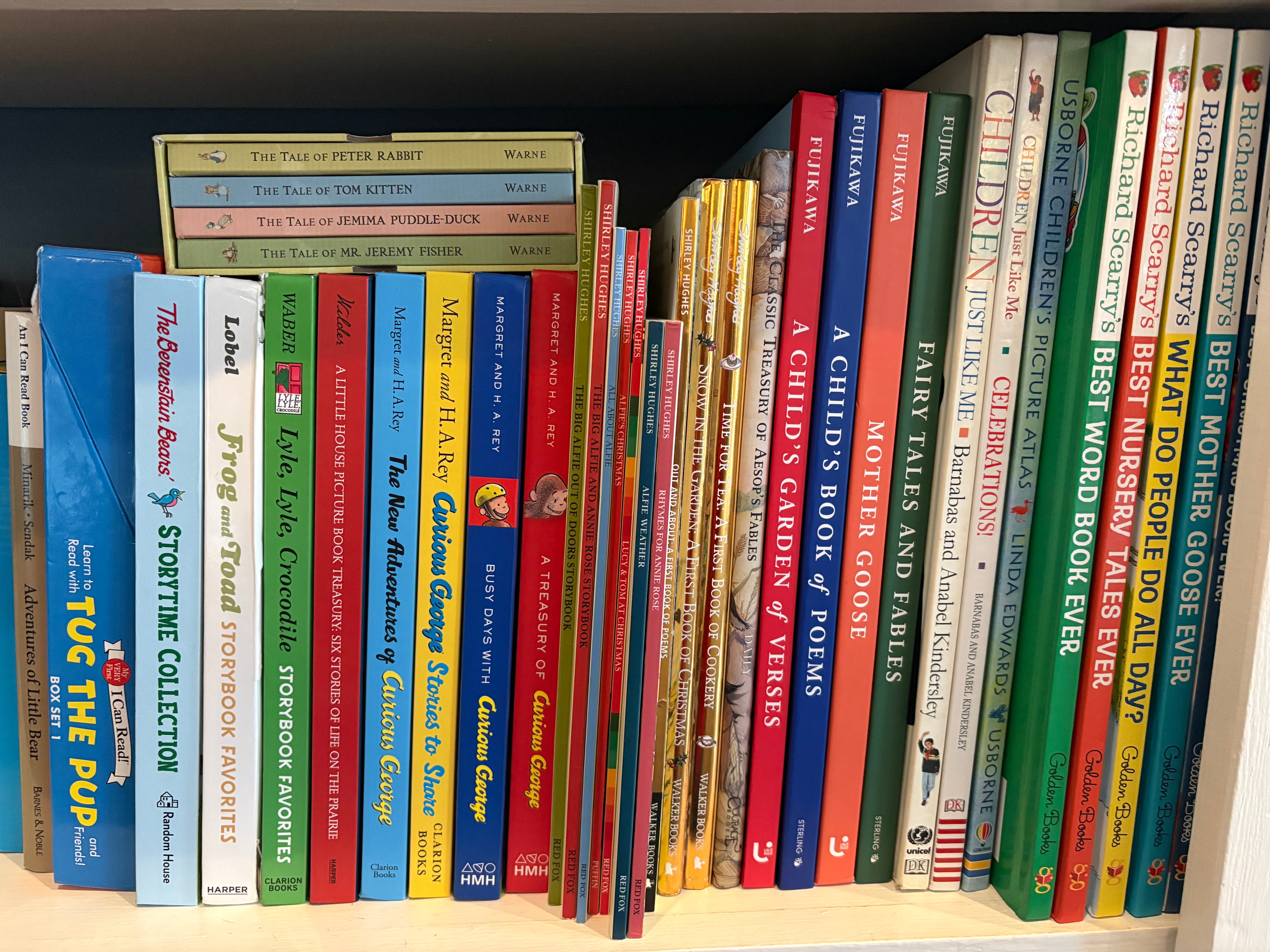
This picture is, at once, an example and an exaggeration of the goal of homeschooling.
When I say that the kindergarten and nursery school years should look like this bookshelf, what I mean is that 1) it can be as simple as regularly reading from thoughtfully selected books, and that 2) these early childhood books can be the basis for much more learning.
Obviously, there is more to a homeschool year than just books, but a stocked homeschool shelf will be the beating heart and steady foundation of your day. It will also be a haven for a weary homeschool teacher on a harrowing day!
Do you need these exact books? No, but many of these would make great additions to your home library.
Teaching from the Shelf
One of my favorite parts—and in some seasons of motherhood, the most challenging parts—of homeschooling is the read-aloud.
While many of us have the idyllic dream of our children sitting patiently on the floor as we, the teacher, read to them from a cozy arm chair, each child giving the page their full attention, it rarely plays out this way.
However, you have a good chance of getting a glimpse of this at a morning read-aloud or right after a well-timed snack.
Another approach to get a read-aloud in for the day is by pairing it with a hands-on activity. I find art time or play time with simple puzzles to be a good time to get an extra book in that day.
Curate a Curriculum
A good tip for teachers is to prepare the shelf ahead of time and keep it close to where you plan to read aloud. This takes the guess work out of what to read.
In choosing what makes it onto the shelf, consider the goals of these early years.
We want children to be immersed in the language of literature. We want to develop their sense of the world, their understanding of sounds, their lyrical ear, their joy.
Yes, of course, we want them to read and write and count and divide, but remember their age. The nursery and kindergarten years are, first and foremost, about rooting children in the joy of learning. With that joy comes the pre-literacy skills, the fine and gross motor skills, the cultivation of curiosity.
When choosing your books, pick titles that will inspire, intrigue, and enlighten their souls. Some books to consider are…
A good collection of Mother Goose or Nursery Rhymes — These might seem simple, but these are the basis of the literary imagination. The rhymes tune the ear to the lyrical rhythms of language. The short lengths are ripe fodder for memorization.
Fairy Tales — These help shape the moral imagination and in a world that obscures evil, these stories make its starkness to goodness black and white. While many people recommend Grimm’s or Anderson’s collections, many others will do as well. (I’m particularly fond of Gyo Fujikawa’s collection!)
Fables — While fables can be delayed to the first year of formal lessons (year 1/first grade,) I’ve found several fables have been a hit with my younger children as well. As these stories incorporate nature, it’s a good opportunity to go outside after reading and look for things related to the fable.
Picture Books — You can choose individual picture books, a series, or both. The stories should have beautiful illustrations (and beautiful doesn’t always mean ornate; As you can see, Curious George makes the cut for our shelf!) These stories should also use language well. While Beatrix Potter’s sentences might be a little old fashioned, your child will love Peter Rabbit and begin appreciating the cadence of Potter’s sentences. For our family, the Alfie series of books is beloved and strikes the perfect balance between simplicity of story and complexity of language.
Poetry — You almost don’t need this if you have a quality collection of nursery rhymes, because there can be much overlap between children’s poetry collections and nursery rhymes. However, poetry is a vital aspect to our children’s learning! I’d recommend a quality collection of children’s poems to read from during your homeschool week. I’ve often paired our poetry with tea at snack time!
Beyond the Page
Let the homeschool shelf be a steady anchor for you throughout the day. Reach for a book two or three times throughout the day and you’ll find a rhythm will start to develop. However, don’t let your child’s learning end when you close the book.
Use these books as jumping-off points to explore more. How do you do this?
Nursery rhymes often have songs or movements to accompany them and most can be found online. Listen or dance along. Sing the songs and practice the movements. Recall these rhymes when you’re outside with your children and encourage them to recite them with you. This builds memory, tunes the musical ear, and supports a growing sense of language.
Look to nature for elements from a story you’ve read. I mentioned earlier doing this alongside fables. My children especially loved reading the fable “The Crow and the Pitcher” and then, going outside to drop rocks into a bucket so that they could watch the water rise. This creates integrated and organic to their education.
Play out a story you’ve read. If you read about Curious George at a fire station, play out what a fireman might wear, what one might do at work, what the fire engine sounds like. If reading about someone at the market, play out following a shopping list and buying or selling items. These acts build an understanding of narratives, of the social workings of the world, and foster a growth of communication.
Let them explore. This is how the magic of homeschooling in the early years truly grows. They may count the caterpillars and butterflies they see, and you can talk about how they are the same insects and how that—which seems impossible—could be. (In doing so, you may remember you have a book on butterflies and add it to the shelf!) They can use wooden block letters to learn phonetic sounds. They can pick up different items and you ask if it’s big or small, or if it’s heavy or light, if it will sink or float, and so on.
Every moment is a chance for curiosity and learning.
Simple & Repeatable
One more thing that ought not to be neglected in these early years is rereading. Rereading helps develop language, solidify ideas, and spur the imagination. This should ease the mind of a teacher worried she might not have enough books.
You don’t need a full bookcase. You just need a simple shelf of well-chosen books and to read to your children as your day allows.
I hope this post gives some confidence to those just beginning their homeschool journey in the early years. Kindergarten and the nursery years can and should be full of wonder and joy! Be encouraged knowing that setting the tone for wonder in the homeschool can actually be simple and repeatable.
If you enjoyed this, you may like some of my other articles:


When I was unsure of whether or not I could ever handle homeschooling, a teacher friend of mine said: “Lauren, if all you do is read really good books to your children you will be doing the bulk of the work right there.” In we dove, reading the Chronicles of Narnia, Little Princess, Paddington, A Christmas Carol and more. So many read alouds. So much time spent with my kids immersed in good literature. It’s been the biggest blessing, and I do think that what my friend said was undoubtedly true. It is the greatest treasure to read aloud to your kids.